For clinics · Spec sheet

DS1800Veterinary chemistry analyzer

Biochemistry and urine analysis. One compact analyzer.

Lab-quality biochemistry and urine analysis in a single 4.5 kg device, so clinics can diagnose companion and exotic animals with confidence in one run.
Talk to sales
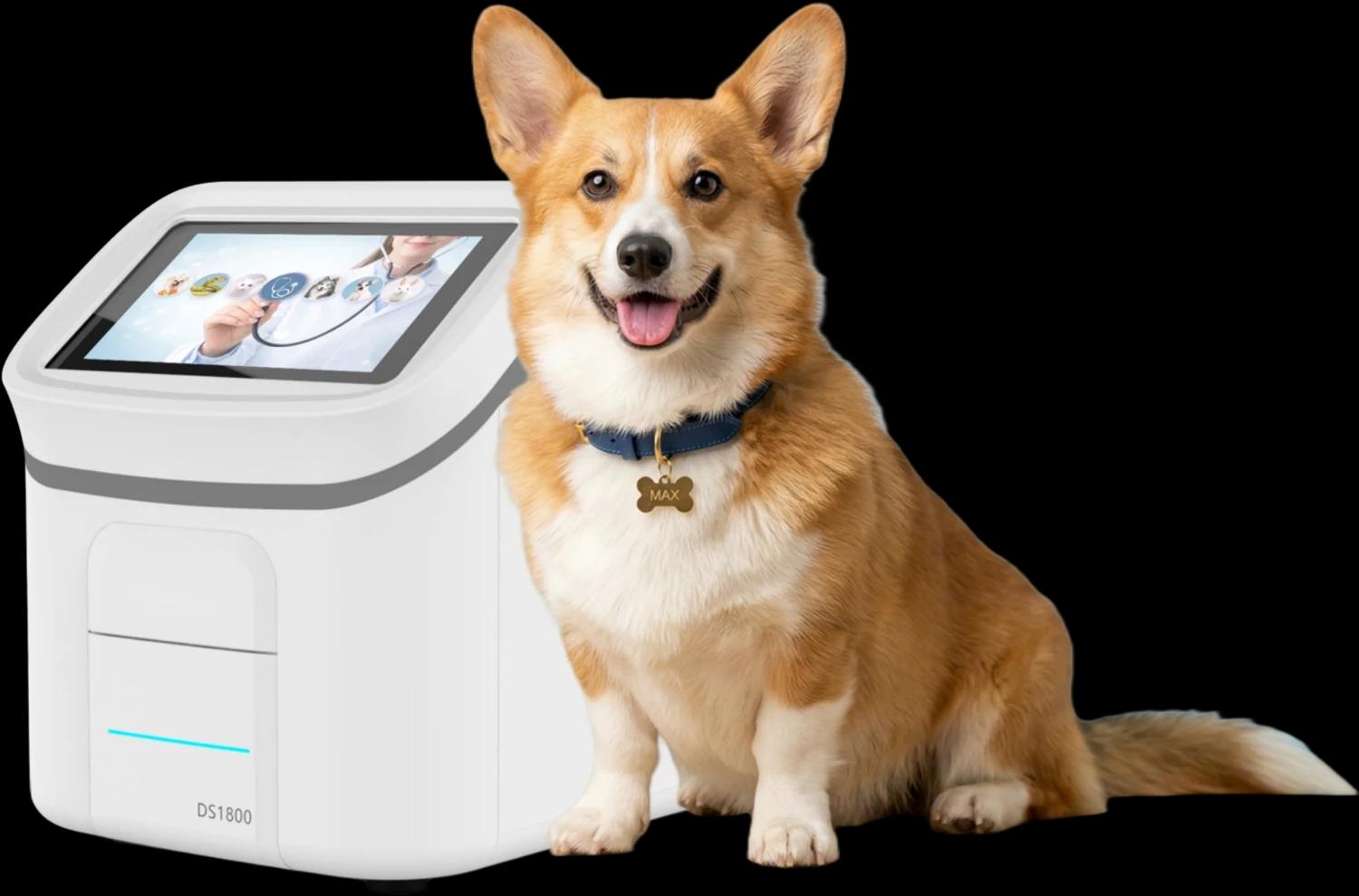
The DS1800 analyzer next to a corgi
2 in 1
Biochemistry and urine analysis in one device
4.5 kg
Ultra-portable, with a carry handle
≤15 min
Per run, up to three sector plates in parallel
8 λ
Wavelengths read in sync, 340⁠–⁠700 nm

Core advantages

Precision you can act on, without a second analyzer.

Fully automated and built on microfluidic reagent discs with photoelectric colorimetry, it runs whole blood, plasma, serum and urine on one platform. Replacing separate biochemistry and urine analyzers simplifies the workflow and cuts equipment cost.

Consistent and accurate

Dynamic value assignment reduces error between reagent batches, with system traceability to international standards.

Intelligent monitoring

Built-in real-time automatic quality control raises timely alarms, so every result is one you can trust.

Maintenance-free

An LED cold light source and no liquid circuit mean nothing to service across the analyzer’s life cycle.

Rapid and portable

Weighs only 4.5 kg with a convenient carry handle, and delivers accurate results in under 15 minutes.

Workflow

Three steps, no films to tear.

  1. 1

    Load the sample

    Pipette whole blood, plasma, serum or urine straight onto the reagent disc or sector plate.

  2. 2

    Insert the disc

    The analyzer reads the disc’s QR code and applies the batch calibration automatically.

  3. 3

    Read the result

    Results appear on screen within 15 minutes, print on the built-in printer, and can be sent to your LIS.
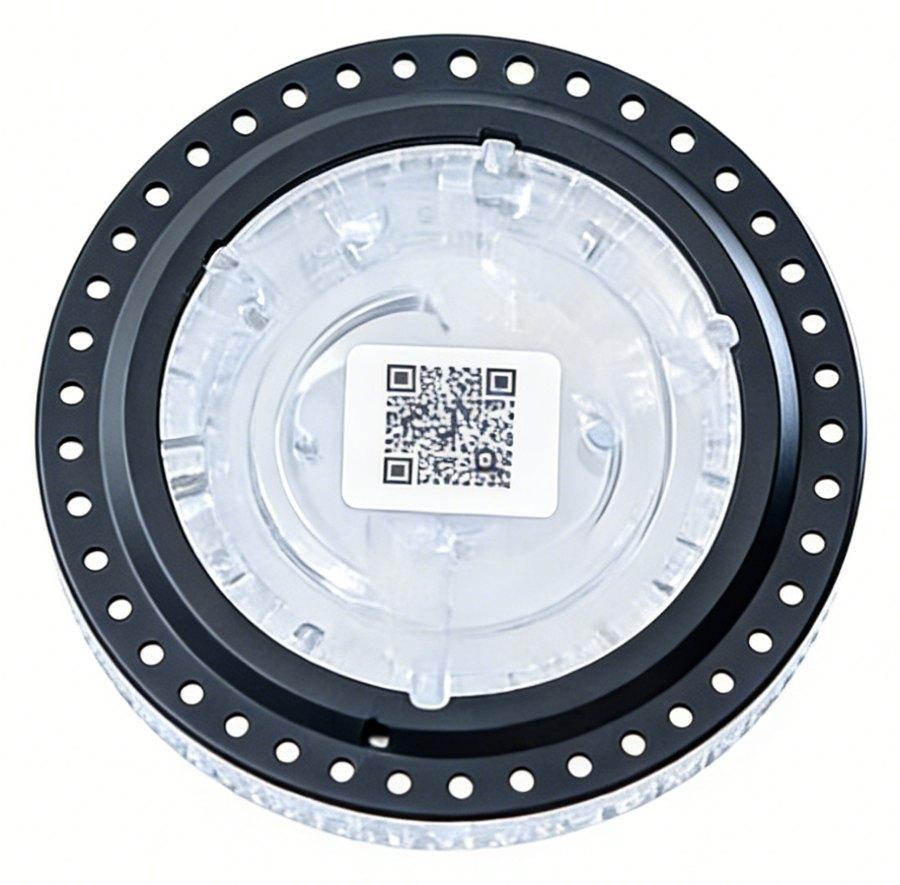
A reagent disc with its QR-coded calibration label

Reagent discs and sector plates

Each disc carries its own QR-coded calibration. Load the sample and insert the disc; there are no reagents to prepare.

90⁠–⁠120 µL
Full disc
50⁠–⁠70 µL
Sector plate, run 3 in parallel
200 µL
Urine

Reagent panels

Six panels for diverse clinical needs.

Routine screening, organ function and infection markers for dogs and cats. Every analyte on a panel runs from one sample in a single pass. Dark chips are ratios calculated from the measured analytes.

Electrolyte

13 analytes
  • K⁺
  • Na⁺
  • Cl⁻
  • Ca²⁺
  • Crea
  • pH
  • Mg²⁺
  • GLU
  • Phos
  • tCO₂
  • LAC
  • BUN
  • B/C

Feline infection

8 + 2 analytes
  • f-SAA
  • BUN
  • ALB
  • TBA
  • ALP
  • GGT
  • TP
  • GLOB
  • A/G
  • B/C

Diabetes

9 analytes
  • ALT
  • AMY
  • AST
  • GLU
  • LPS
  • TC
  • TG
  • LAC
  • FRUC

Canine infection

2 analytes
  • AMY
  • c-CRP

Liver function

10 + 1 analytes
  • ALB
  • ALT
  • AST
  • ALP
  • CK
  • Crea
  • GLU
  • LDH
  • TP
  • BUN
  • B/C

Renal function

7 analytes
  • ALB
  • Crea
  • Ca²⁺
  • GLU
  • PHOS
  • CO₂
  • CysC

Sample types

Whole blood, plasma, serum and urine. One analyzer for every routine sample.

Patients

Designed for companion animals, with reference support for exotic species.

Three samples at once

Sector plates take 50⁠–⁠70 µL each and run three in parallel, so a busy morning’s samples are back in 15 minutes or less.

Software

Intelligent software, connected to your practice.

AI data interpretation

Expert interpretation of every result lets veterinarians and owners understand a pet’s condition quickly, with actionable next steps.

Intuitive operation

A 7-inch 1280 × 640 multi-touch capacitive screen guides each run. Simple manual steps, and no films to tear.

Robust connectivity

Stores up to one million patient records. Two USB ports, a network port, a built-in thermal printer and full LIS support.

Technical specifications
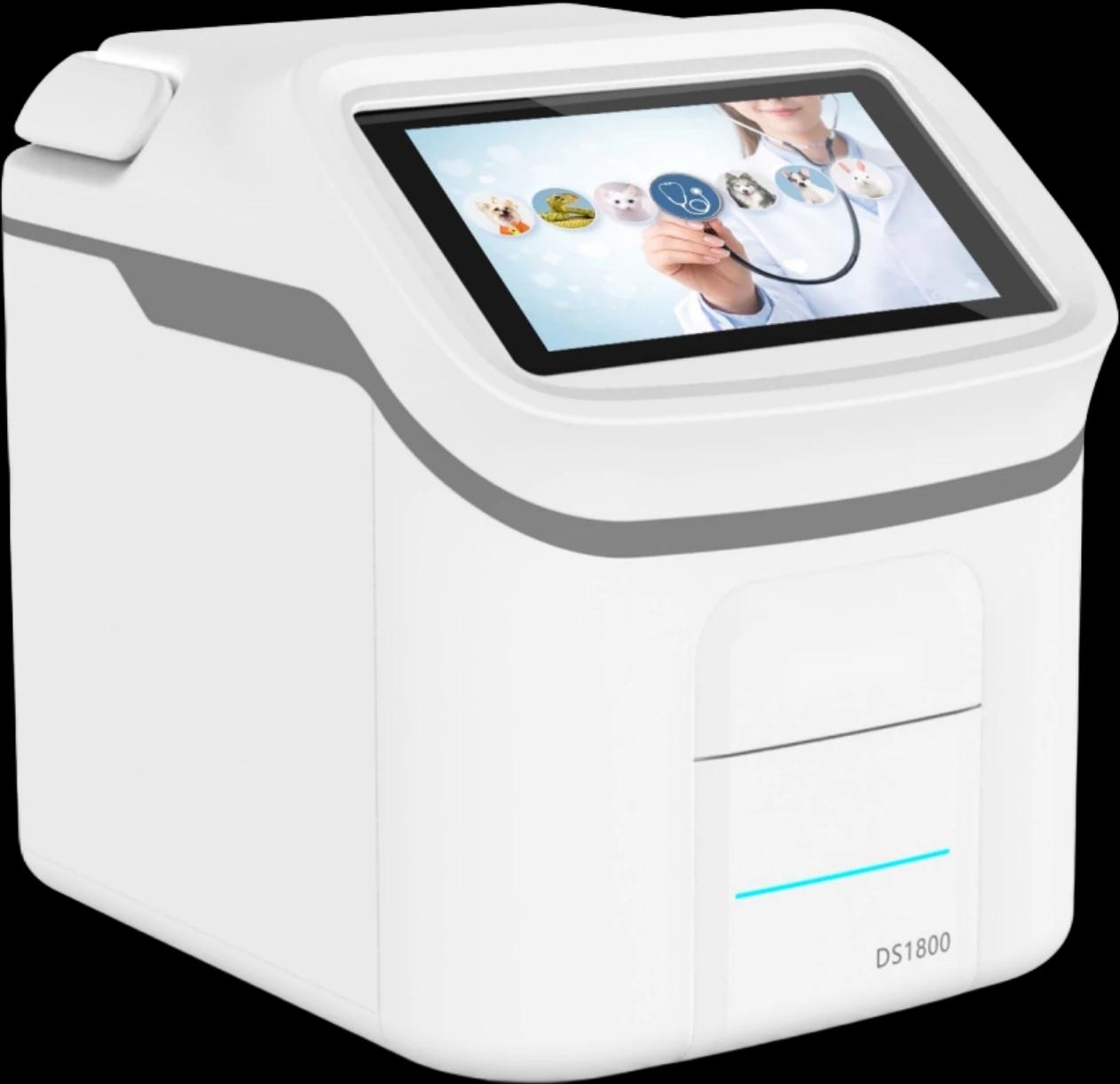
The details.

The DS1800 analyzer
Sample type
Lithium heparin whole blood, plasma, serum, urine.
Sample volume
Disc 90⁠–⁠120 µL · Sector plate 50⁠–⁠70 µL · Urine 200 µL
Testing principle
Photoelectric colorimetry, absorption spectroscopy, transmission turbidimetry.
Testing time
Single sample 9⁠–⁠15 minutes. Three sector plates in parallel, total ≤ 15 minutes.
Optical system
LED maintenance-free cold light source. 8-wavelength synchronous detection, 340⁠–⁠700 nm.
Operating environment
Temperature 10⁠–⁠30 °C, reaction control 37 ± 0.3 °C. Humidity ≤ 85 %.
Display
7-inch capacitive multi-touch screen, 1280 × 640.
Interfaces
2 × USB, 1 × network port, built-in thermal printer, LIS support.
Data storage
Up to 1,000,000 records.
Dimensions
230 mm (W) × 290 mm (D) × 300 mm (H)
Net weight
4.5 kg

Hematology · HC-5000

HC-5000 5-part hematology analyzer.

A complete blood count with a 5-part differential from under 20 µL of blood.
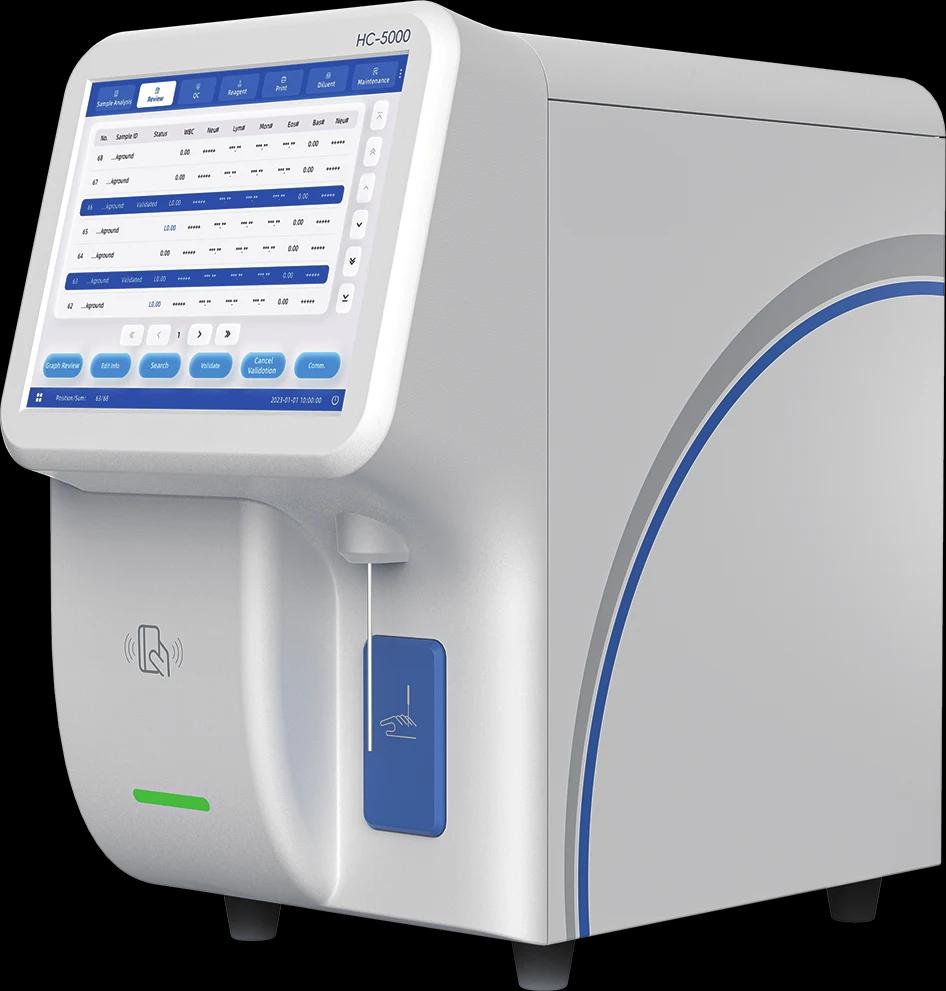
The HC-5000 hematology analyzer
Parameters
25 reported: WBC, RBC, HGB, HCT, MCV, MCH, MCHC, RDW-SD, RDW-CV, PLT, MPV, PCT, PDW, P-LCR, P-LCC, plus NEU, LYM, MON, EOS and BAS as % and #. 4 research: ALY%, ALY#, LIC%, LIC#.
Graphs
3D scatter plot, 2D scatter plots, WBC/BASO scatter plot, RBC and PLT histograms.
Technology
3-angle semiconductor laser scatter, flow cytometry, electrical impedance, cyanide-free HGB measurement.
Modes
CBC + DIFF. Venous whole blood, pre⁠-⁠diluted peripheral blood, anticoagulated peripheral whole blood.
Throughput
60 samples per hour
Sample volume
Under 20 µL (CBC + DIFF)
Display
10.4-inch touch screen, 800 × 600, works with gloves, no external computer needed.
Reagents
Built-in lysing reagent, quick reagent change.
Data storage
100,000+ results, including histograms, scatter plots and patient details.
Interfaces
1 × network port, 2 × USB, two-way LIS (HL7), external USB printer. Optional Wi⁠-⁠Fi and RFID reader.
Power
100⁠–⁠240 V AC, 50/60 Hz
Environment
10⁠–⁠30 °C, 20⁠–⁠85% humidity, 70⁠–⁠106 kPa, up to 2,000 m altitude.
Dimensions
280 mm (W) × 460 mm (D) × 470 mm (H)
Weight
About 30 kg

Performance

ItemLinear rangeCarryoverRepeatability (CV)
WBC0⁠–⁠100 × 10⁹/L≤ 0.5%≤ 2.0%
RBC0⁠–⁠8 × 10¹²/L≤ 0.5%≤ 1.5%
HGB0⁠–⁠250 g/L≤ 0.6%≤ 1.5%
PLT0⁠–⁠1,000 × 10⁹/L≤ 1.0%≤ 4.0%

Specifications subject to change without notice.

Continuous glucose monitoring

Glucose, monitored between visits.

Our CGM sensors give a glucose reading every 3 minutes for up to 16 days, without fingerpricks. A practical tool for managing diabetic dogs and cats under veterinary guidance.
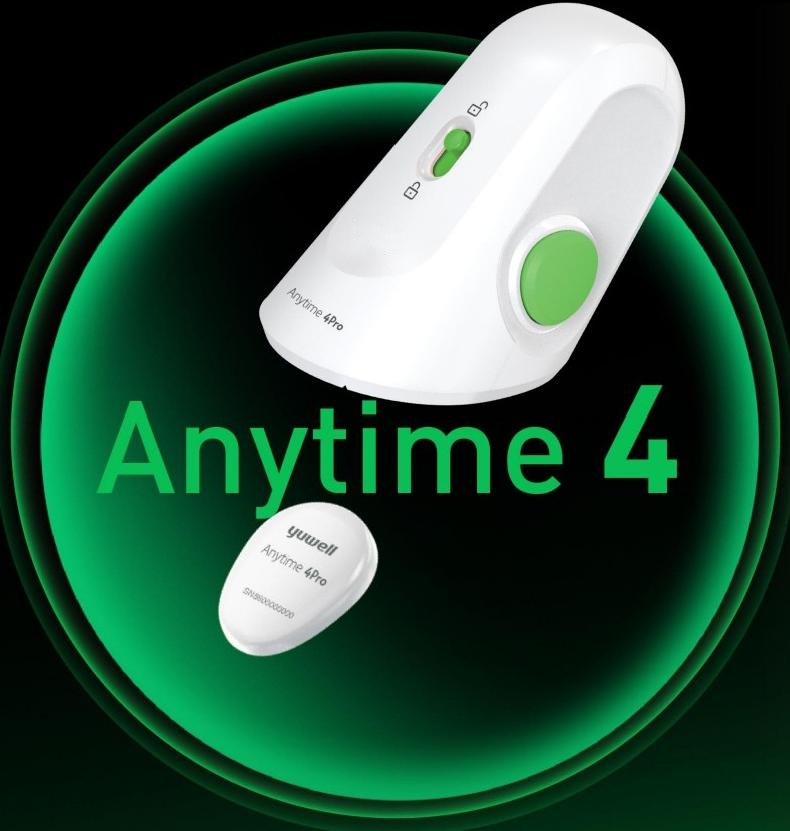
15-day sensor glucose sensor and applicator

15-day sensor

15 days
Sensor wear
8.68%
MARD, calibration-free (8.31% with weekly calibration)
3 min
Reading interval, 7,200 readings per sensor
  • Reusable transmitter reduces medical waste
  • Smart algorithm with trend arrows
  • Hybrid calibration: calibration-free, or optional weekly calibration
16-day sensor glucose sensor and applicator

16-day sensor

16 days
Sensor wear
8.58%
MARD across the full wear period, no calibration
3 min
Reading interval, 7,680 readings per sensor
  • One-piece sensor, 23 × 4 mm and 2 g
  • 45-minute warm-up
  • Two-step insertion, one-step connection

CE MDR and NMPA approved for human use. Sold in 110+ countries. Accuracy (MARD) and wear figures are from human clinical studies; use in dogs and cats is off-label and should be guided by a veterinarian.

Bring the lab to your clinic.

Pricing, demos and availability: our team will get back to you.

Talk to sales